Goal graph prior
An LLM proposes plausible rooms, anchor objects, and relations for the requested category. Hypothetical objects remain distinct from detections.
Zero-shot object navigation via graph matching
* Corresponding author
Prepared for arXiv submission. An arXiv identifier has not yet been assigned.
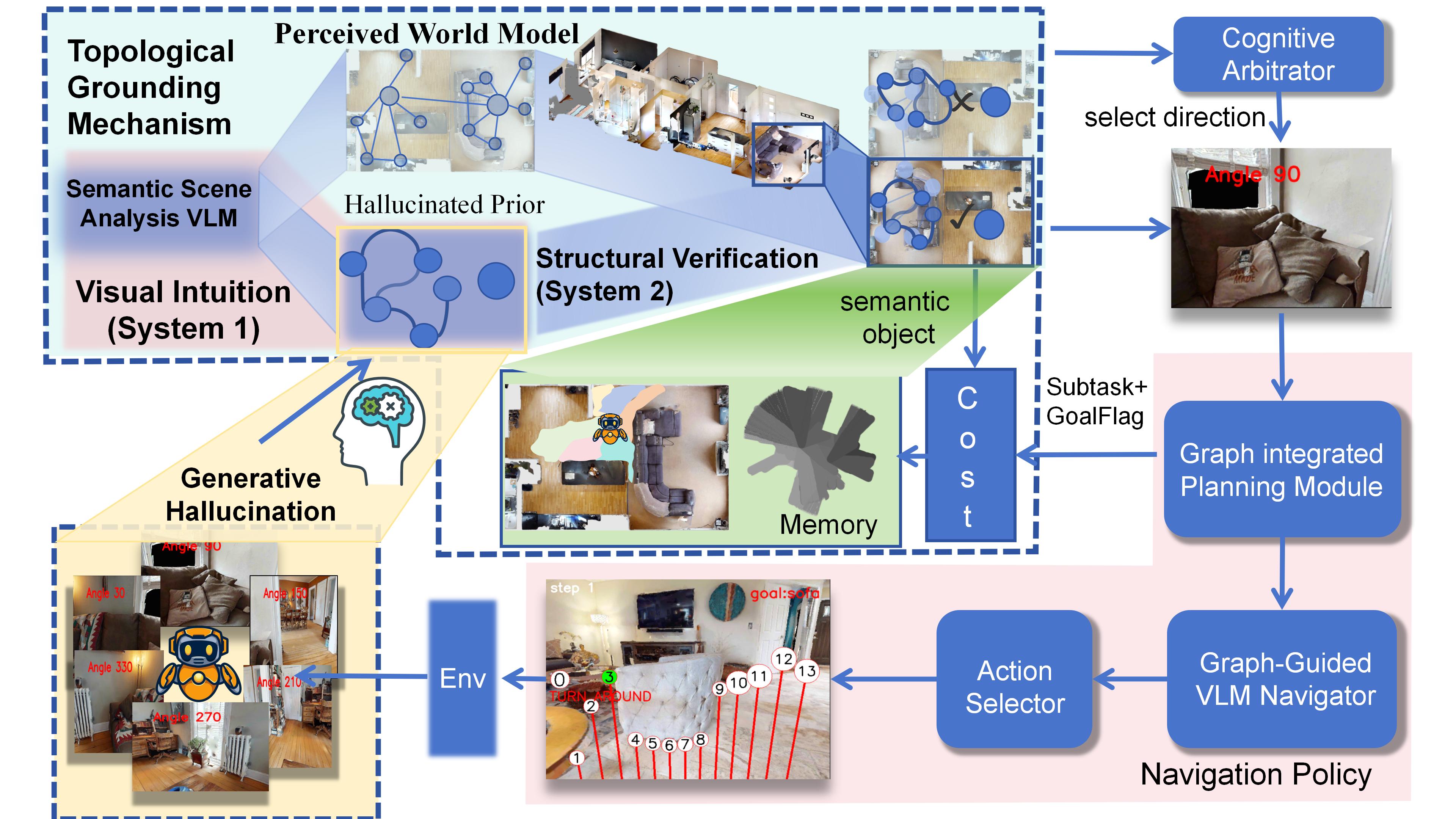
Finding an object in an unfamiliar environment requires more than recognizing what is visible. HGWM expands the target category into a room–anchor graph prior, maintains persistent spatial-semantic memory, and compares the two to rank candidate directions.
A coarse VLM score captures visual opportunity. Explicit symbolic matching adds structural evidence, and a phase-dependent fusion rule combines it with an LLM recommendation before local action selection. The graph is a hypothesis and observation record, not verified ground truth.
Separate prior knowledge from observed evidence and from the computation that connects them.
An LLM proposes plausible rooms, anchor objects, and relations for the requested category. Hypothetical objects remain distinct from detections.
RGB-D observations accumulate object and room information. Current evidence and retrieved memory share a consistent graph representation.
Room, object, spatial, semantic, and depth features contribute to direction scores. The implementation uses symbolic comparisons, not a learned graph-embedding network.

Success rate (SR) and success weighted by path length (SPL), in percent.
| Method | HM3D v0.1 SR | HM3D v0.1 SPL | MP3D SR | MP3D SPL |
|---|---|---|---|---|
| WMNav | 58.1 | 31.2 | 45.4 | 17.2 |
| HGWM | 62.6 [62.3–62.8] | 31.5 [31.2–31.7] | 46.8 | 17.9 |
Brackets show the observed range across three HGWM runs on HM3D v0.1, not confidence intervals. Baseline values are taken from the cited work and use its experimental settings. The SPL range includes WMNav's point estimate.
| Configuration | SR | SPL |
|---|---|---|
| Basic VLM / no memory | 67.8 | 29.3 |
| Voxel memory + direct scoring | 70.9 | 30.1 |
| HGWM | 74.4 | 31.9 |
| Without goal prior | 72.1 | 30.8 |
| Without relation refinement | 72.1 | 30.4 |
| Without LLM arbitration | 72.7 | 31.1 |
| Non-adaptive fine weights | 73.5 | 31.3 |
The non-adaptive row is a single weight configuration. These ablations examine components of the full system; they do not isolate every interaction between representation and decision making.
18 archived cases · 338 indexed steps · 337 available text logs.
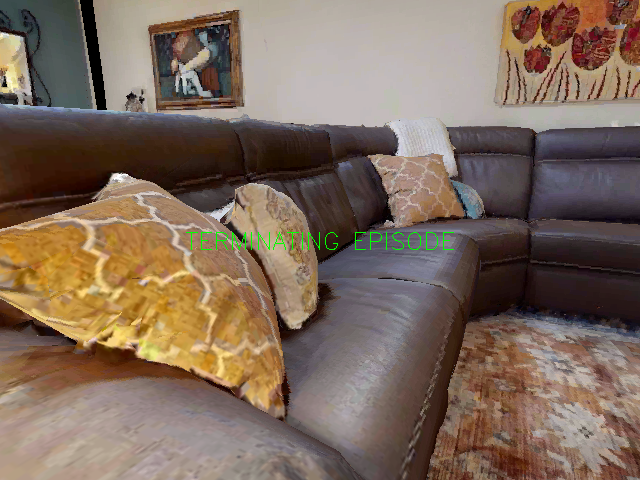
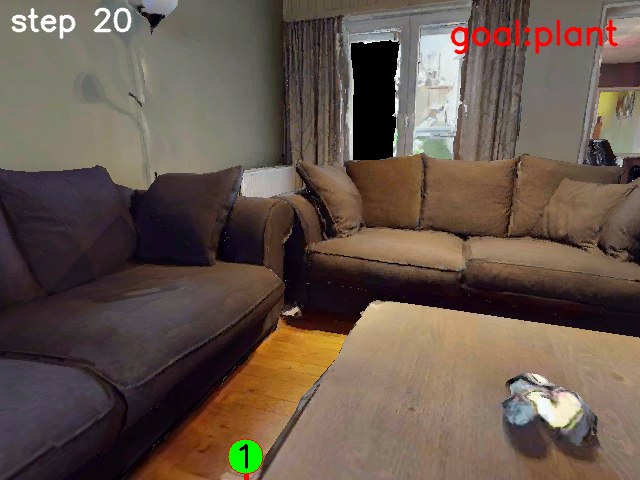
Original images and annotations are preserved. The examples illustrate observations and decisions during navigation; they do not constitute a paired benchmark comparison.
Browse all 18 cases →This record does not claim conference acceptance or an assigned arXiv identifier.
@misc{ieong2026hgwm,
  title  = {HGWM: Hierarchical Graph-Guided World Model for Zero-Shot Object Navigation via Graph Matching},
  author = {Ieong, I-Tak and Tang, Hao},
  year   = {2026},
  note   = {Preprint},
  url    = {https://github.com/itak04/HGWM}
}